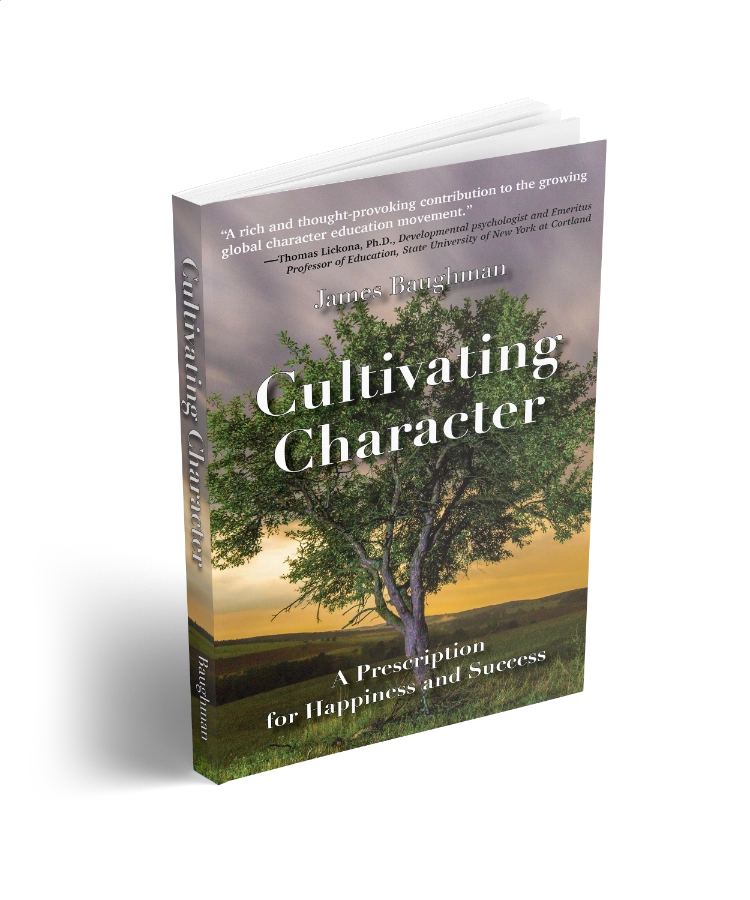
Cultivating Character Book
A Prescription for Happiness and Success

According to Aristotle, “character is that which reveals moral purpose, exposing the class of things a person chooses and avoids.” It not only determines the reputation of an individual but also impacts on the reputation of social institutions and the nation as a whole, since these are comprised of individuals.
According to Thomas Lickona, becoming a person of character necessarily requires three sequential and integrated components: to know the good, to love the good and to do the good. This theme creates the framework of the book as it systematically explores these three components in detail.
The purpose of something is associated with the way it is designed. Its functionality determines its value. That which fulfills its purpose is considered useful and good; that which fails to do so is thought to be useless and bad.
Human beings are not only universally designed to function in certain ways physically, but also metaphysically. Our purpose is to live in accordance with that design if we are to prosper and fulfill our greatest potential. We hurt ourselves and others when we violate or contradict that design.
A key component to that design is creativity which by nature is relational and stimulates joy and contentment. The extent of that joy depends on the effort that one invests and the motivation underlying that investment.
All human activity is a creative act and can be categorized into Four Life Goals, or objectives. These include becoming a mature individual self, a mature parent, a mature citizen and a mature creator. Our purpose, then, is to experience ultimate joy through the accomplishment of these four aspirations. Anything that promotes and enhances our ability to fulfill this purpose is good; anything that inhibits me or others from doing so is counterproductive and evil.
In addition, we are designed with four innate desires which are neutral in nature and indispensable in accomplishing the four objectives. These include the desires for personal excellence, sexual intimacy, influence and material prosperity/comfort. How we channel the use of these desires determines whether or not we achieve the Four Life Goals to their greatest potential.
Goodness, then, is anything that assists in achieving our purpose in terms of how we are designed. It is any thought, word or deed that utilizes the four natural desires for the benefit of others at the sacrifice of self. This motivation, also called “True Love,” allows for everyone and everything to fulfill their purpose, i.e., the Four Life Goals. The virtues and wisdom espoused by the time-honored moral philosophers and religious teachers offer guidance in how this is accomplished.
Evil, on the contrary, is any thought, word or deed that manipulates these four desires for the benefit of self at the sacrifice of others. This ultimately results in loss, misery and destruction for everyone and everything concerned. The moral and religious traditions warn us of this behavior and the consequences that befall us when we ignore a virtuous lifestyle.
The family is designed as the ideal institution to initiate and nurture True Love and the proper use of our four natural desires. In this sense, it prepares us from birth to align ourselves with the attitudes and conduct necessary for us to fulfill the Four Life Goals and helps us to later project what we have learned into the larger social arena. In this regard, the family is the “first school of life” and our parents become our first teachers or mentors in the process of becoming fully human.
Central to the family’s success is the marriage between a man and a woman, each of whom brings a unique perspective and contribution to the process of raising the next generation.
The marriage between a man and a woman is the only relationship in which the natural desire for sexual intimacy is to be pursued as it allows for the full expression of that desire in terms of generating love, life and lineage without fear, guilt or constraint. For there to be a consistent and stable environment for love, life and lineage to be nurtured and protected within the family, marriage has to be enduring.
The only way for this permanence to be generated is for the husband and wife to develop the highest standard of love in all that they say and do, i.e., living life for the sake of others. In this sense, a husband and wife must be dedicated to cultivating good character prior to making a marriage commitment.
While character can be developed outside of the family institution, it is more difficult especially when we have already developed habits of using our natural desires for the benefit of self at the expense of others. However, through a process of discipline not unlike that experienced within the family, we can train ourselves to reverse our undesirable habits and establish ones of virtue and goodness.
All learning involves this process of discipline which originally means “to teach.” By knowing the nature and mechanics of discipline we can more deliberately apply the process to quickly and effectively bring about the desired results.
The discipline of self-transformation and cultivating character involves learning the good, doing the good and eventually loving the good by achieving proficiency and mastery. The Character Mirror can be used as a tool to guide us through a daily process of goal setting, practice and self-reflection. The “Mirror” is a chart that consists of the Four Life Goals, their respective natural desires, relevant virtues and their counterparts.
While some may find it easier than others to start and navigate through this process, we are all destined to achieve our greatest human potential for success and happiness just as we are designed to live and breathe.


We can learn universal insights from the great religious and moral philosophical traditions about how people are created as ‘moral beings’. In addition, we can discover that certain attitudes and behaviour patterns, in keeping with this moral intention, can result in strong self-esteem and success in all our interactions.
Alternatively attitudes and actions contrary to this objective can lead to a life of misery, suffering and destructive relationships. Thus the key to creating a happy and fulfilling life appears to be in understanding how we are intended to be and the inevitable implications this proposes.
A variety of presentations are available to explore the nature and implementation of character development including classroom presentations in high schools and colleges, evening colloquia in the community, and 1- or 2-day seminars. If you are interested in learning more about attending or arranging one of these types of sessions, please contact me at character@baughmaneducation.com or complete the information below.